Delta Plus - How Will it Help with Your Contamination Control Strategy?
 BlogSalle blanche30.07.2026
With the launch of our new Delta Plus cleanroom detergent, we answer some of the most frequently asked questions about detergent use, explain how Delta Plus improves on its predecessor Delta, and explore how it supports an effective cleanroom contamination control strategy.
Why Do We Need to Use a Dedicated Detergent for Our Cleanroom?
Cleaning and disinfection are often confused, but they serve different purposes:
- Cleaning removes visible and invisible contamination such as particles, soils, residues, oils, and films.
- Disinfection reduces microbial contamination to an acceptable level.
Disinfectants are not designed to remove heavy soils and are significantly less effective if applied to dirty surfaces.
Why are both needed?
Effective contamination control relies on both steps:
- Cleaning removes the materials that can protect microorganisms and reduce the efficacy of the disinfectant.
- Disinfection can then act effectively because microorganisms are no longer protected by soil or residues.
Using Delta Plus as the cleaning step helps ensure that disinfectants, like Alpha and Beta, can work as intended, improving the effectiveness of the overall contamination control strategy.
How is Delta Plus an improvement on its Delta predecessor?
Delta Plus represents an evolution of the original Delta formulation, with targeted improvements to both environmental impact and user safety, while maintaining effective cleanroom cleaning performance.
Delta Plus improves on the original Delta formulation by:
- Using naturally derived surfactants instead of petrochemical based alternatives, reducing dependence on non-renewable raw materials and supporting responsible sourcing.
- Eliminating preservatives that required additional hazard labelling, contributing to simpler product handling.
- Maintaining cleaning performance, ensuring effective removal of residues and contamination.
The result is a detergent that delivers effective cleanroom cleaning while supporting responsible sourcing, improved user safety and reduced environmental impact.
How does Delta Plus Compare to Other Detergents?
Micronclean have undertaken a comprehensive validation programme for Delta Plus. Part of this included comparative testing of various detergents’ capability to remove disinfectant residue.
Disinfectant was applied to a surface using a mop, and this surface was then mopped using either Delta, Delta Plus, or a leading competitor detergent.
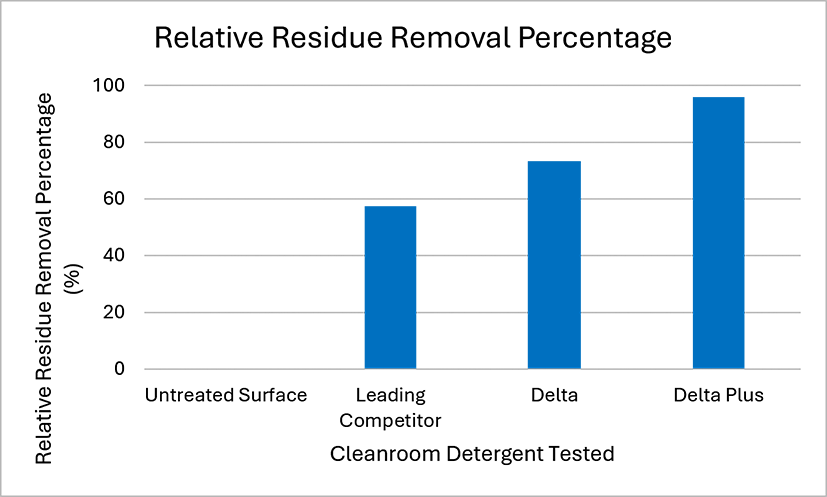
The results of this showed that Delta Plus achieved the highest performance in this study, removing 96% of the disinfectant residue on the surface.
Why Can’t we use Other Cleaning Fluids Instead?
Each cleaning fluid has a different role:
- Detergents (like Delta Plus) are most effective at removing adhered soils, oils, films and disinfectant residues.
- Alcohols (e.g. IPA) are good at removing light residues and evaporate quickly, but they are poor at removing heavier or greasy contamination and can spread residues rather than remove them. Alcohols are also generally unsuitable for Cleaning large floor areas because of rapid evaporation and the generation of vapours.
- Purified Water or Water for Injection (WFI) is good at rinsing away any potential minimal detergent residues but has limited cleaning power on its own.
Practical cleaning studies consistently show that detergent cleaning, followed by a water rinse if appropriate, provides a controlled and reproducible cleaning process in cleanroom environments.
Why not view our Delta Plus range of cleanroom neutral detergent products.

L'auteur
Tasmin Crompton
Responsable technique